

There is a structural fight coming in crypto markets, and most participants don't know they're already in it.
On one side are the exchanges. Their business model runs on assets sitting on-platform and more assets means more liquidity, more lending revenue, more user retention, and a stronger pitch to the next institutional prospect. The exchange is not indifferent to where your collateral sits. It has a strong preference, and that preference is architecturally baked into how their platforms work.
On the other side are custodians. Their pitch to institutional clients has always been straightforward: assets under custody are assets under protection. Regulatory compliance, insurance frameworks, segregated accounts, balance sheet integrity. The custodian's value proposition collapses the moment a client moves assets off-platform to meet exchange prefunding requirements, which is exactly what most institutional crypto participants are currently doing.
While in the middle the institutions themselves, trying to get the benefits of both and absorbing the full costs of each. They want custodial safety because their risk and compliance teams require it. They want multi-venue execution because concentration in any single exchange is itself a risk, and because the best price for a given trade is rarely on the platform where most of their collateral is parked. The current market structure doesn't give them a way to have both, so they build workarounds: fragmenting assets across venues, duplicating operational overhead, and managing a collateral footprint that would raise eyebrows in any other asset class.
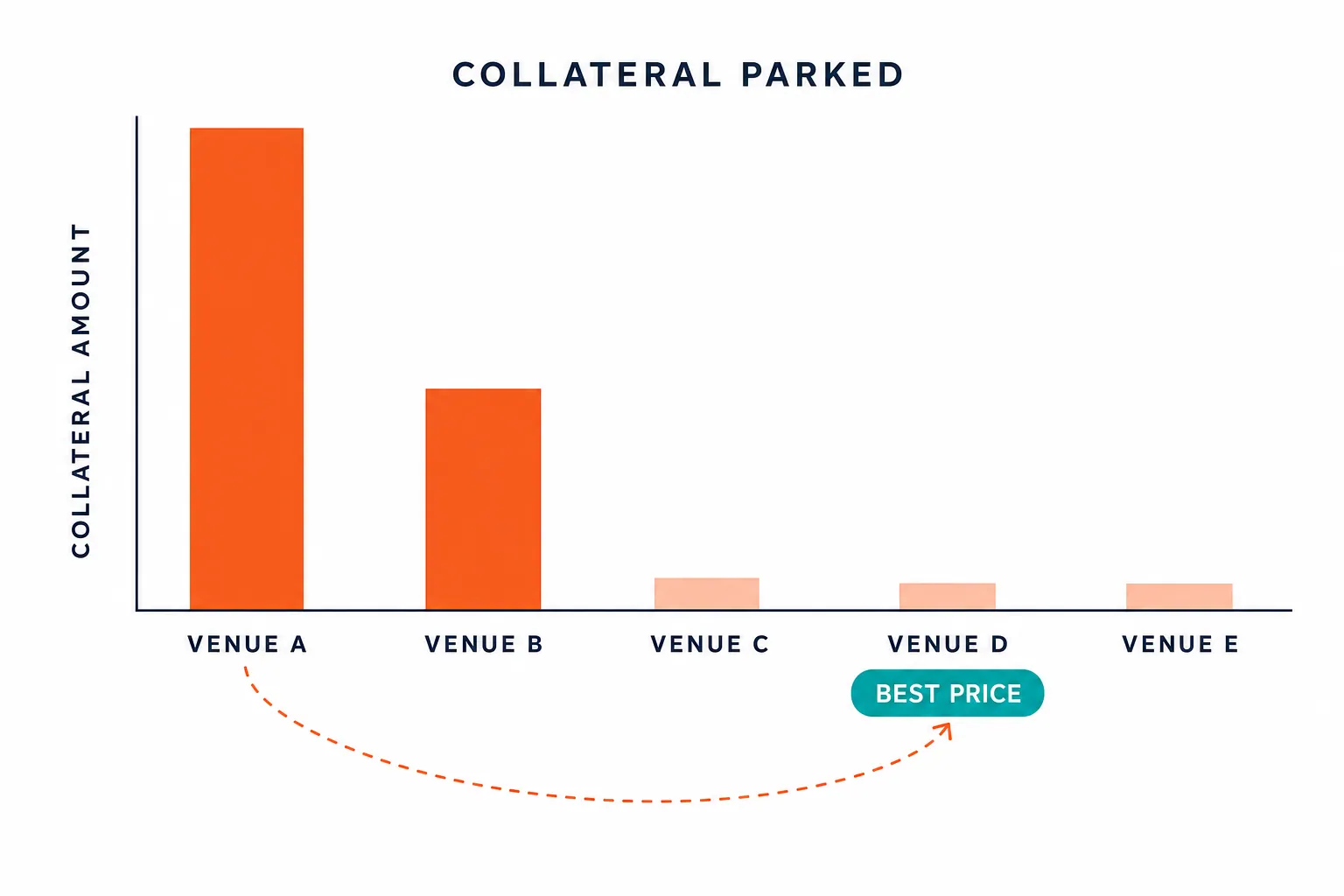
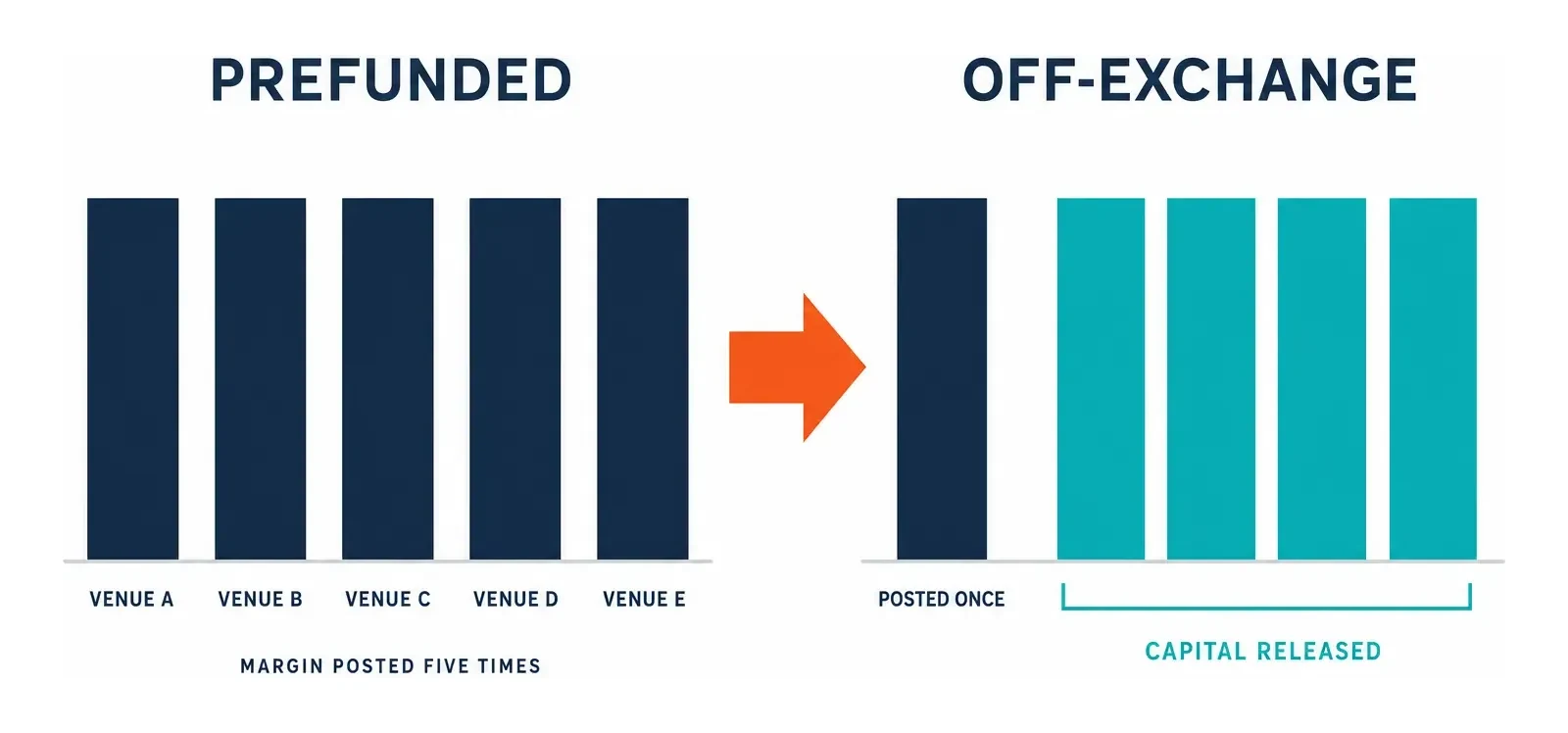
There is historic precedent we can look to, when prime brokerage emerged in traditional finance, exchanges held the structural high ground. They set the rules, controlled the infrastructure, and captured the economics of institutional participation. Prime brokers changed that by doing something conceptually simple: they decoupled execution from the balance sheet. An institution could trade across multiple venues through a single prime relationship, posting margin once rather than everywhere, with the prime absorbing the operational complexity of managing settlement across counterparties. Over time, the prime broker became the institutional relationship. The exchange became the venue.
Crypto is approaching the same inflection. The exchange model still dominates because the infrastructure to route around it hasn't existed at scale. Prefunding has been a structural requirement, not a choice. Institutions have adapted to the constraint rather than solving it, partly because solving it required coordination across venues, custodians, and counterparties that nobody had incentive to drive unilaterally.
That's changing. The firms building off-exchange settlement infrastructure or systems that let positions net and margin move between custodians rather than sitting on exchange are doing something that looks like a technical service but is actually something more consequential. If your infrastructure makes custodians the center of the capital stack and turns exchanges into execution endpoints, you haven't built a settlement utility. You've built the equivalent of a prime brokerage layer, and handed custodians the institutional relationship.
Exchanges understand this, or will. The response will probably not be subtle: proprietary custody products, tighter integration between on-platform assets and execution, preferential pricing that makes off-platform collateral less attractive. Some exchanges are already there. The question for institutions is whether the convenience of that integration is worth the concentration risk, and whether the regulatory trajectory — OCC permissibility, joint SEC/CFTC taxonomy, a Congress at least nominally engaging with market structure — makes custodial separation more or less important going forward.
The institutions moving into crypto with serious capital are not going to accept a model that requires them to pledge assets to venues as a precondition of trading. That model was designed for retail and was never built for the balance sheet constraints and counterparty risk limits that govern institutional capital allocation. Better legal clarity on what crypto assets are doesn't change the fact that the assets are still sitting on exchange, exposed to exchange counterparty risk.
Infrastructure is never neutral. Every design decision about where margin sits, who controls asset movement, and what triggers settlement is a decision about which entities retain structural leverage and which become execution utilities. The exchanges that capture this layer retain the institutional relationship. The ones that don't become venues.
The outcome will determine whether crypto market structure evolves into something resembling TradFi at its best. Which is separated custody, multi-venue execution, capital working efficiently or if the industry stays locked in a model that the institutions with the most capital will eventually decide isn't worth tolerating.
Zane Suren is Chief Revenue Officer at BridgePort, where he leads the company's global revenue strategy, commercial architecture, and sales organization as BridgePort scales its institutional off-exchange settlement network. Before joining BridgePort, Zane spent more than three years at Zodia Custody, the digital asset custodian backed by Standard Chartered, serving on the institutional revenue team across the custody and technology businesses.