
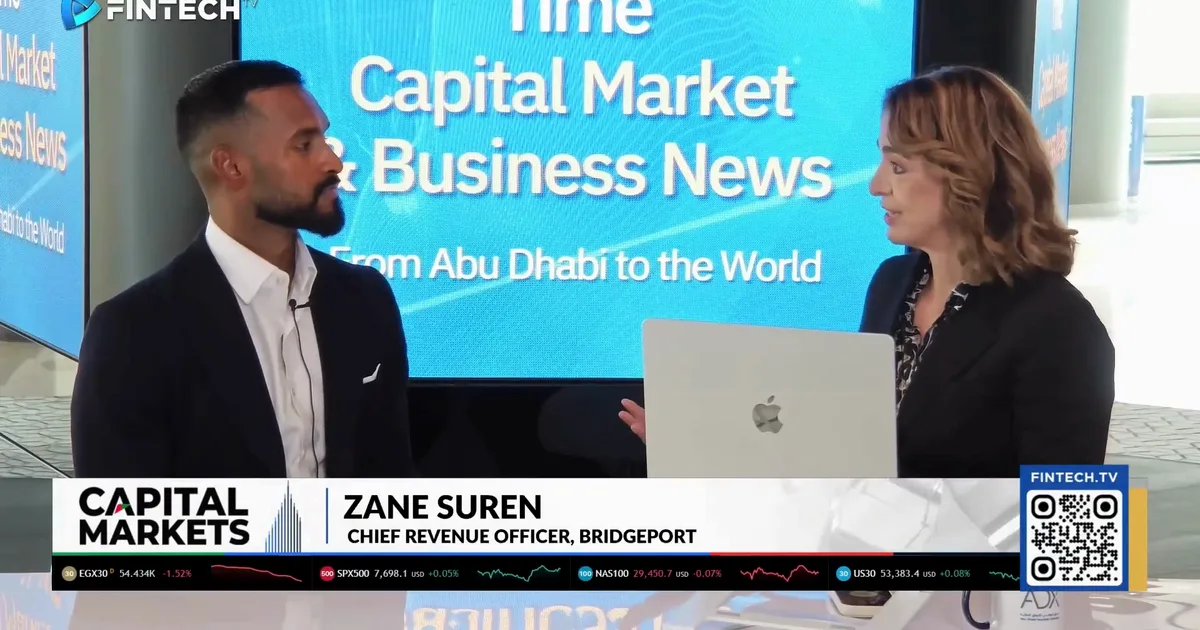
Zane Suren, BridgePort's Chief Revenue Officer, sat down with Fintech TV's Capital Markets in Abu Dhabi to work through a question that sounds simple and is not. Why does trading crypto still tie up money that trading anything else does not?
What BridgePort Does
The problem starts with the order of operations on a trade. In an established market a firm's assets sit with its custodian, the firm trades on whatever venue it likes, and settlement follows afterwards. Decades of shared infrastructure are what make that last step feel automatic.
Crypto reversed the order. The money goes to the venue first, and it stops working the moment it lands.
BridgePort sits between the custodian and the venue rather than replacing either. A firm keeps its assets where they already are, trades wherever it wants, and BridgePort handles the two jobs that bracket the trade, allocating credit before it and netting settlement afterwards. It runs as an API layer and never takes custody of anything.
Read the transcript
Let's kick off with what BridgePort does exactly, if you wouldn't mind explaining what's the big problem in crypto markets that you guys are solving. So in traditional markets, trading firms keep their assets in custody. They would then trade on an exchange of their choice and then settle, and that happens like magic. Now in crypto markets, the norm seems to be to pre-fund an exchange, which means it's a very inefficient way to operate that capital.
And so BridgePort connects custodians to exchanges, so an institutional trading firm can choose any custodian of choice, store their digital assets securely with that custodian and then trade on any venue of their choice, exchange, OTC desk, etc. So we perform two functions, a credit allocation function and post-trade, the settlement netting function as well, purely as an API layer.
How Much Capital This Strands
The figure that circulates for the industry is $60 billion sitting idle across pre-funded exchange accounts. Our own view is that the real number is higher.
The reasoning is structural. A desk trading eight venues pre-funds all eight, and it is not working all eight at once. It funds them because it might need to, and the cost of being ready is paid every day whether the opportunity arrives or not. Most of that capital is doing nothing most of the time.
Pre-funding is not a fee that shows up on a statement. It is working capital that cannot do anything else for as long as it sits there.
Read the transcript
I mean, it's a really big problem, right? So I think the number was 60 billion worth of funds that are sort of captured and the inefficiency that's built into the system. So you're effectively unlocking that 60 billion and letting it flow far, far, far faster, right? Yes, we actually think it's a significantly higher number because this is trapped capital.
And what that means is, let's say a trading firm trades on eight venues, they would pre-fund each of those eight venues. Most of the time that capital isn't being put to work. So 60 billion is probably on the lower side. And we can really, once we unlock the connectivity between the various players in the market, it should be allowing capital to flow a lot more efficiently.
Standardizing the Paperwork
Technology is not the only thing standing between a firm and a venue. Even when the plumbing works and the regulator is satisfied, the lawyers are not.
Every off-exchange relationship still opens with a triparty negotiation covering dispute resolution, settlement frequency, collateral treatment and default. Two to six months is a normal round, the same negotiation restarts with each new counterparty added to the picture, and almost none of the work carries over.
The Digital Asset Master Agreement is our answer to treating that as a per-relationship problem. DAMA uses existing ISDA documentation as a base and standardizes the terms that rarely need to differ. A working group of trading firms, custodians and exchanges is forming to pilot it across live relationships.
Read the transcript
…about this DAMA, D-A-M-A, really an ISDA for digital assets. So that's pretty revolutionary, I would say, because it's very needed in crypto markets to have these traditional finance sort of standards and guidelines. And ISDA, as we all know from the GFC in 2008, is an incredibly long, comprehensive set of rules and guidelines.
So tell us more about DAMA. Yeah, one of the biggest challenges, I think, in this space right now, the digital asset spaces, even if the technology is there connecting custodians, exchanges, and trading firms to be able to trade, even if the regulatory approval is there, they still need to have legal triparty agreements which allow them to put in place things like dispute resolution, settlement frequency, and so on.
And we noticed that all different client types were having the same issues. They would take two to six months to negotiate these terms, and it would be very painful. And then when they brought on clients, aside from the trading exchanges and the custodians, they would renegotiate. And so even though we're not in the legal agreement, the Digital Assets Master Agreement, DAMA, is a set of frameworks which uses the ISDAs as a base to help standardize across the industry.
And we hope that, as part of the industry's growth, we hope that the participants would support that. Now, we've actually seen today a lot of support by a working group. So if you are a trading firm, we'd love to have you join in. A shout out for those that contribute. Yeah, I mean, it takes a village, right, to come up with these things.
But great initiative from BridgePort, and I guess sort of seeing that gap. And there's just many problems that's still to be worked on in crypto to really close that gap between traditional finance and the crypto markets.
Why Abu Dhabi
Abu Dhabi Global Market set out its first digital asset framework in 2018, years before most regulators had a position at all.
What that bought was clarity, and clarity is the actual product a regulator sells to anyone deciding where to build. Infrastructure is a ten, twenty, fifty year bet, which is hard to justify against rules that might still move.
ADGM's early position is a large part of why firms are choosing the emirate now, and the consistency of the FSRA's approach in the years since is why the market has taken it seriously.
Read the transcript
So, let's talk about digital asset growth in the MENA region. You guys obviously have a front row seat in what's going on here, all the trading activity. Tell us about what's happening in ADGM, the trading of crypto, the trading of digital assets. What's your take on it all? So I think ADGM has been one of the few regulators globally that has demonstrated from a very early period in the digital assets ecosystem a forward-thinking attitude, stance, and actual action with regards to the frameworks around digital assets.
I think 2018 was the first framework set out, and that's effectively providing clarity for firms. Entrepreneurs, especially in a new tech era, want clarity. They want settled rules around how they can build, because this is a 10, 20, 50-year infrastructure bet. So, that bet has now recently paid off with a lot of firms coming to the region to set up hubs here.
We obviously saw Coinbase's news earlier this week, and it demonstrates that the collaborative attitude that the FSRA has always demonstrated for the last years has been one that the market has received very well. We're very, very bullish on the region, and Abu Dhabi and the UAE as well as a whole will be the hub for digital assets ecosystem growth on the institutional side, certainly in this region.
What Coinbase Choosing ADGM Signals
The clearest evidence that the bet paid off is who is showing up. Coinbase has placed its international tokenization hub in ADGM.
Regulating an asset and approving it are the first step. Infrastructure that lets capital move without friction is the second, and that is the step BridgePort is building. It is also why the pre-funding question and the Abu Dhabi question turn out to be the same question. Regulatory clarity brings institutions to a market. Whether they can deploy capital efficiently once they arrive is a matter of plumbing.
Read the transcript
I think when we have a name like Coinbase setting up their international tokenization hub right here in ADGM, I mean, it's giving a very strong signal to the market. Do you see that sort of kicking off a chain reaction of activity? Is that really sort of a flag in the sand and we're going to see a lot more players and maybe US players actually come and set up shop for tokenization purposes, infrastructure purposes?
Absolutely. So regulation of an asset is the first step. The approval is the first step. The infrastructure, being able to enable capital to flow effortlessly is the second. And I think the fact that Coinbase has planted resources, commitments here to the region, to Abu Dhabi in particular, demonstrates a proof point that the regulator was correct in their bet.
Now, naturally, what happens then is the plumbing catches up and that's what we're looking to support the ecosystem with. I think definitely we're going to see more folks come here and utilize the regulatory clarity that we have here.
Zane Suren was interviewed on Capital Markets by Fintech TV in Abu Dhabi.
Connect with us to see off-exchange settlement on your own flow.